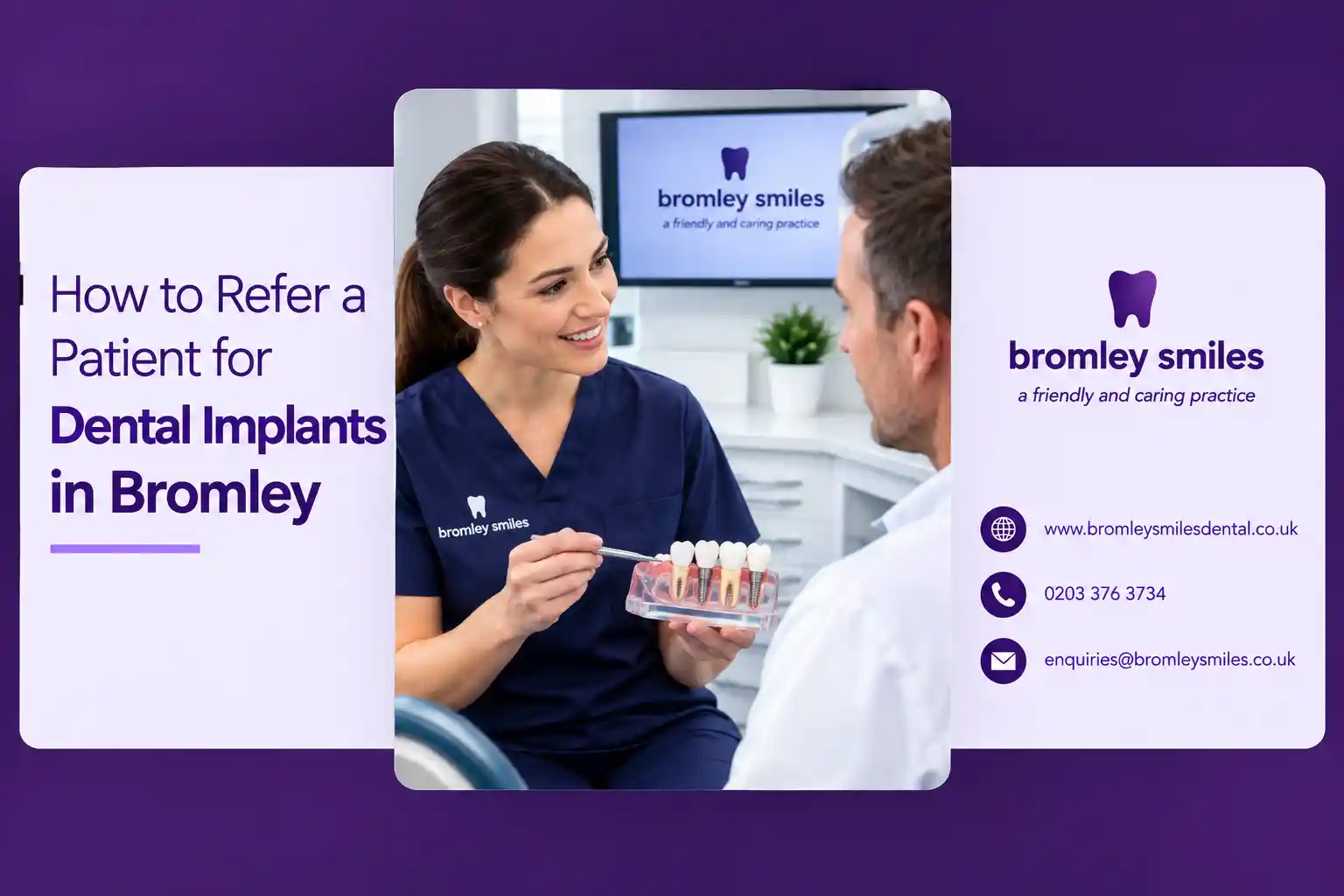
Knowing how to refer a patient for dental implants in Bromley properly can make a real difference to how smoothly treatment progresses. A clear referral, with the right information included from the start, helps our team assess the case quickly and gives the patient confidence that everything is being handled properly.
At Bromley Smiles Dental, we accept implant referrals from general dentists across Bromley and the surrounding areas. This guide walks through the dental implant referral process step by step, from deciding a referral is appropriate through to how we communicate with you once treatment begins.
If you’ve already read our overview on our implant referral page for dentists, think of this as the more detailed, practical companion to that.
When a Referral May Be Appropriate
Before getting into the process itself, it helps to be clear on when referring makes sense. Common scenarios include a patient with one or more missing teeth, an unstable denture, or a failing bridge where implant supported options might be worth exploring.
Patients with more complex needs, such as significant bone loss or multiple missing teeth requiring a full arch approach like all on 4, often benefit from earlier referral so there’s time for proper planning.
If you’re ever unsure whether a case is suitable, our team is happy to have an informal conversation before a formal implant referral for dentists is submitted.
What Information to Include in a Referral
A good referral gives us enough detail to prepare properly for the patient’s first visit, without needing to chase for missing information afterwards. The more complete the referral, the more efficient the assessment appointment tends to be.
Dental and Medical History
Relevant dental history, including previous extractions, periodontal treatment or existing restorative work, helps us understand the full picture before the patient arrives. Medical history matters too, since certain conditions and medications can influence implant suitability and healing.
It’s also useful to note any medications the patient is currently taking, along with any relevant allergies.
Existing X-rays
If you already have recent radiographs, including these with the referral avoids unnecessary repeat imaging for the patient. Even where further imaging is needed on our end, existing X-rays give useful context early on.
CBCT Imaging Where Appropriate
For more complex cases, particularly where bone volume is a concern, a CBCT scan gives a much clearer three dimensional view of the jaw. If this has already been carried out, including it with the referral is helpful, though we’re also able to arrange this ourselves as part of the assessment.
Clinical Photographs
Clinical photographs, where available, help give a fuller picture of the presenting issue before the patient’s first appointment. This isn’t essential for every referral, but it can be a useful addition for more visually complex cases.
Submitting the Referral
Once you have the relevant information gathered, referrals can be sent to our team via our contact page, by email, or by phone. We aim to acknowledge every referral promptly and will get in touch if anything further is needed before booking the patient in.
Patients themselves can also book their initial assessment directly through our online booking portal once the referral has been received, which keeps the process moving without unnecessary back and forth.
Patient Assessment at Bromley Smiles Dental
The first appointment after referral is a thorough assessment. This typically includes a clinical examination, a review of the patient’s history and goals, and imaging where needed to assess bone quality and structure.
This stage is important because implant suitability depends on several individual factors, including bone density, gum health and general medical wellbeing. We’re never able to confirm a treatment plan without this assessment, and we always explain this clearly to patients so expectations are realistic from the outset.
Where relevant, we may also discuss related options such as crowns and bridges or prosthetics, depending on what best suits the individual case.
Treatment Planning After Assessment
Once the assessment is complete, we put together a personalised treatment plan. This sets out the proposed approach, whether that’s a single implant, multiple implants, or a more involved solution such as all on 4 for patients missing most or all of their teeth.
We talk patients through timelines, what to expect at each stage, and any preparatory treatment that might be needed first, such as a bone graft or extraction. Costs are also explained clearly at this point, with dental implants starting from £2,500 and full arch treatment from £12,500. A complete breakdown is available on our fee guide, and patients can also ask about 0% APR finance through Tabeo if spreading the cost would help.
For patients also interested in the appearance of their smile alongside implant treatment, our smile makeover page covers complementary options such as veneers and teeth whitening.
Communication With the Referring Dentist
Good communication throughout is something we take seriously. We aim to keep referring dentists updated at key stages of treatment, so you know how your patient’s case is progressing without needing to chase for updates.
Once implant treatment is complete, many patients return to their general dentist for ongoing check ups and preventive care, and we’re happy to provide a clear summary to support that handover.
Supporting Patients Across Bromley and Surrounding Areas
We regularly accept referrals for patients based in Bromley itself, as well as those travelling in from Bickley, Chislehurst, Petts Wood and Orpington. Our clinic on the High Street in Bromley is easy to reach from these areas, with appointments available Monday to Friday between 8am and 6pm.
If distance or travel time is a concern for a particular patient, it’s worth mentioning this when submitting the referral so we can plan appointments accordingly.
Frequently Asked Questions
Referrals can be sent via our contact page, email or phone, ideally including relevant dental and medical history. Patients can then book their initial assessment through our online booking portal once we’ve received and reviewed the referral.
Useful information includes dental and medical history, existing X-rays or CBCT imaging if available, and clinical photographs where relevant. The more complete the referral, the smoother the first assessment tends to be.
No. CBCT imaging is helpful where available, particularly for complex cases, but we’re able to arrange this ourselves as part of the patient’s assessment if it hasn’t already been done.
Yes. We aim to communicate with referring dentists at key stages of the implant referral process, and provide a clear summary once treatment is complete for continuity of care.
Yes. Many patients return to their original dentist for ongoing check ups and hygiene care once implant treatment has finished, and we support this handover with clear clinical notes.
This depends on current availability, but we aim to see referred patients for assessment promptly. Patients can also book their own appointment through our booking portal once the referral has been received.
In Summary
A well prepared referral makes the whole process smoother for everyone involved, from the referring dentist through to the patient themselves. Including relevant history, existing imaging and clear notes on the presenting issue helps our team plan an efficient and thorough assessment.
If you have a patient who may benefit from dental implants, our team at Bromley Smiles Dental is ready to help. Referrals can be sent through our contact page, and patients are welcome to book their assessment directly through our booking portal. You can also read more about our full approach on our implant referrals for dentists page, or encourage your patient to arrange their appointment via our portal when they’re ready to move forward.